The resort is a dominant typology in the American West. Originally a tool for exploring and understanding nature, it has evolved into an artificial oasis: something completely isolated from the reality of its environment. As desert civilization in the American West becomes more prone to drought, it is important to understand the scarce and volatile conditions of the desert. For this project, we propose to create an alternate resort network and building typology, which aim to engage in the ecology of their surroundings by registering the flux, which is inherent to the desert environment. By processing phenomena and fluctuations in its environment, the resort will allow the visitor to become aware of the extremes, which are integral to the identity of the desert.
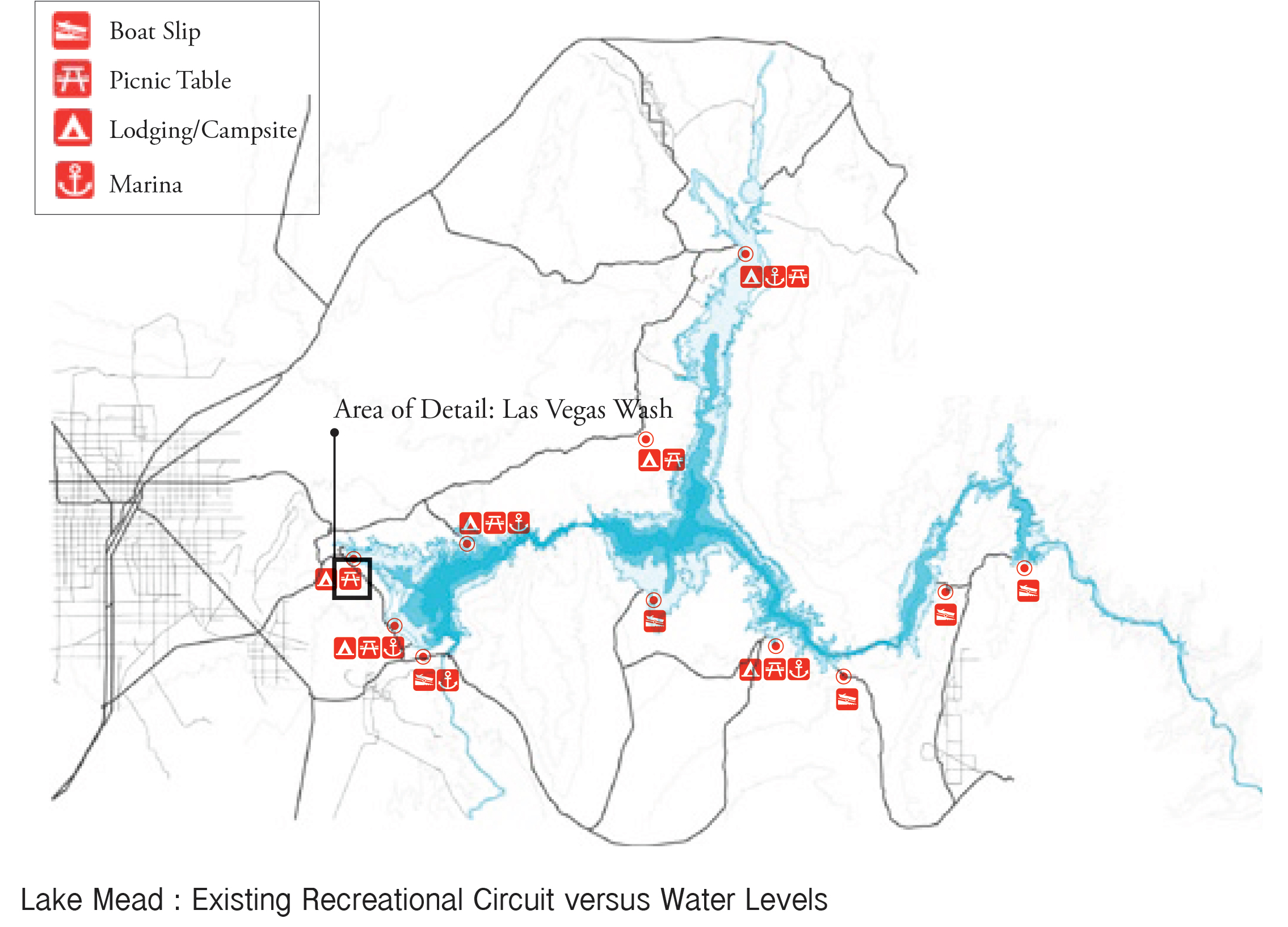
We chose the parched shores of Hoover Dam's Lake Mead as our place of intervention and research for this project. We started this project by researching the existing recreational network centered on the lake. This circuit is based on the lake maintaining certain water levels and is centered on water based activity (house boats, water skiing, swimming, etc). However, as we know from recent years, drought and the inherent fluctuations of "nature" have caused Lake Mead to literally dry up. Thus, this recreational network which has been set up by the National Park Service here, is becoming obsolete.
So what do we do with it?
We propose to create a new resort network adjacent to the old one. The "new" resort is located in the ecologically active zone of the desert wash adjacent to Lake Mead. The wash is an element that is literally carved in to the desert floor by the violent flash floods. It is something which registers the extreme nature of the desert. Whereas Lake Mead represents a man-made constant, the desert wash embodies the uncontrollable flux of nature.
DESERT FLUX : A New Resort Typology for the American West